

~600 days
Forty repeatedly suspended children can mean six hundred days of lost learning, in a group small enough to name.
(DfE; CSJ exclusions tracker)
30% vs 10%
Pupils with a probable mental health condition are three times more likely to miss over a week of school.
(NHS England, 2023)
11 vs 2.5 per 100
The national suspension gap between pupils on SEN support and their peers. Your governors will ask about yours.
(DfE)
Why this keeps happening
You know their names. You know their parents and their form tutors. The reintegration meeting takes place, is minuted, and changes nothing.
You have the suspension figures. You have the SEND register. You can see persistent absence in your dashboard every Monday morning. Nothing in your career has ever required you to read them together. Somewhere in that join is a pattern your team cannot see.
What the audit looks at
Who is being suspended or accessing internal exclusion regularly and often. The complete picture by SEND, disadvantage, ethnicity and year group, including pupils suspended more than once.
The pupils who keep coming back. Internal exclusion, part-time timetables, off-site direction and alternative provision reviewed and counted alongside.
Whole school culture. What the culture of the school looks like and feels like for disadvantaged and SEND pupils, as well as for all pupils
How early need is spotted. Identification and interventions: what the school's graduated response looks like, whether it meets the needs and what its impact is.
Staff wellbeing and parental engagement. What the wider system looks like and how improvements can impact on attendance, wellbeing and staff retention.
OFSTeD report card
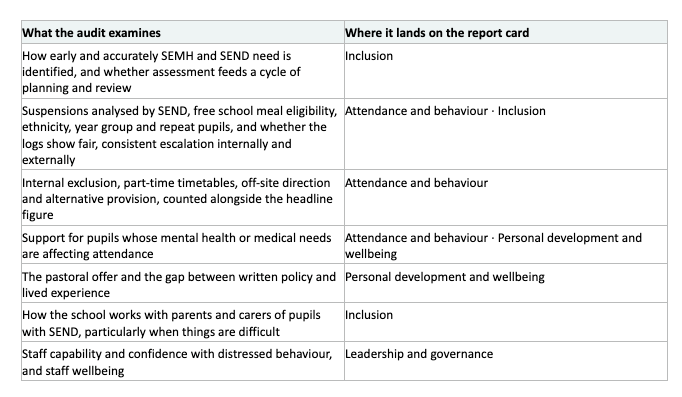
Since November 2025, inspectors have graded inclusion as an evaluation area in its own right, and it threads through achievement, attendance and behaviour as well.
Inspectors want to see need identified early and accurately, records that show suspensions applied fairly and consistently and genuine support for pupils whose mental health affects their attendance, behaviour and learning.
We will not predict a grade or promise one. What the audit gives the school is evidence informed, research backed improvements and a plan.
The questions heads ask us
“What will you tell me that my deputy hasn't?” We won't know until we have read your data and undertaken the audit process. There are several reason why schools want an external review so they can understand the gaps and strengths; because there’s a high prevalence of SEMH needs and nothing is improving; they are due an inspection and want to understand what to focus on first.
“What’s your experience?” Thirty years in education, twenty of which have been as a strategic consultant and trainer. Thousands of schools visited, national influence as special advisor and lead expert with 5 star ratings, current MAT Directorship and a deep understanding of SEMH/inclusion.
“What’s your approach, I don’t want to waste my resources?” Psychological safety and a partnership approach is key to the success of building trust, alongside challenge ensuring you have specific actions you can implement straight away. Further consultancy is available if you don’t have the capacity or expertise to make the actions a reality.
“How much of my time does this take?” One 30-minute call. One day for the audit, with a plan which will be organised together.
“Who sees the report?” You do. It is your school's document and you decide who else reads it.
“What happens to our data?” We ask for pseudonymised extracts only, with pupil names replaced by your internal identifiers. The data lives on one encrypted laptop, is seen by one person, is never used for anything except your audit and is deleted 1 week after your report, with the deletion logged. Identifiable records are viewed on your premises only and your report names no pupils. A signed data agreement and a one-page security statement come with the engagement letter, written to give your DPO everything they need.
“We've tried a lot of this already.” So has every school we work with. We’re as frustrated as you, so we ensure that the audit is specific and rigorous, evidence informed, aligned to the most up to date government guidance and OFSTed and delivered by a national expert. The day will transform your thinking and approach where it’s needed.
Who delivers it
Anna Bateman, Founder and Director, Halcyon Education
Anna founded Halcyon Education after a career that includes teaching, senior leadership, multi-academy trust directorship, Department for Education adviser and Lead Mental Health Expert at The National College. She co-authored a chapter of the Handbook of Prosocial Education with Dr Mark Greenberg, and contributed to The Big Book of Whole School Wellbeing.
What happens next
Most schools take the report and act on it themselves. It is written so that you can. If you choose to, further consultancy and training can be delivered on an agreed schedule or by arrangement, shaped by what the audit found in your school. Schools that want the relationship to continue become Halcyon Partner Schools, with an annual review and access to Halcyon's updated policies and documents throughout the year.